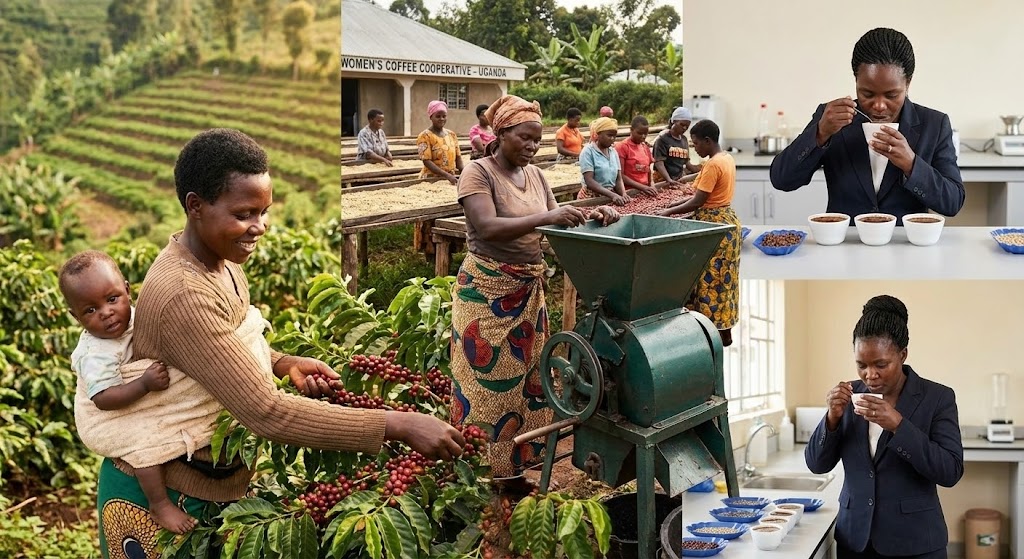
Women are the backbone of Uganda’s coffee sector, yet their contributions often go unrecognized. From planting and harvesting to processing and selling, women perform the majority of labor in coffee production. Understanding and supporting women’s roles is essential for a sustainable and equitable coffee industry.
Women’s Contributions to Ugandan Coffee
Labor Statistics
Women’s involvement in coffee production is substantial:
- 70% of labor: Women perform most coffee farming tasks
- Production activities: Planting, weeding, harvesting, sorting
- Household duties: Processing, drying, and quality selection
- Marketing: Often handle local sales and transportation
Invisible Work
Much of women’s contribution remains uncounted:
- Unpaid family labor on coffee farms
- Domestic work enabling men’s farm activities
- Childcare alongside agricultural tasks
- Food production that supports coffee farming households
Challenges Facing Women in Coffee
Land Ownership Barriers
Land rights remain a significant obstacle:
- Customary laws: Many regions limit women’s land ownership
- Inheritance: Widows may lose access to family farms
- Collateral: Without land titles, women cannot access credit
- Decision-making: Land ownership often determines farm decisions
Limited Access to Resources
Women face resource gaps:
- Credit: Lower access to agricultural finance
- Training: Extension services often target male farmers
- Inputs: Fertilizers and agrochemicals often controlled by men
- Information: Market information networks exclude women
Income Control
Payment systems often bypass women:
- Coffee payments made to male household heads
- Limited control over household income allocation
- Less ability to reinvest in coffee production
- Reduced incentive to improve quality and yield
Time Poverty
Multiple responsibilities limit women’s opportunities:
- Domestic work burden
- Childcare responsibilities
- Water and fuel collection
- Less time for training or meetings
Economic Impact of Gender Inequality
Productivity Losses
Gender gaps reduce coffee sector performance:
- Studies suggest closing gender gaps could increase yields by 20-30%
- Underinvestment in women’s plots reduces overall production
- Limited training reduces quality improvement potential
Poverty Persistence
Inequality perpetuates poverty:
- Household income not fully benefiting family welfare
- Less investment in children’s education and health
- Reduced household resilience to shocks
Progress and Opportunities
Women’s Coffee Groups
Collective organization empowers women:
- Savings and loan groups: Mutual financial support
- Marketing cooperatives: Collective bargaining power
- Training networks: Shared learning opportunities
- Certification groups: Access to premium markets
Gender-Focused Programs
Development initiatives address inequality:
Training programs:
- Women-specific extension services
- Female farmer field schools
- Leadership development
- Financial literacy education
Market access:
- Women-produced coffee labeling
- Direct buyer connections
- Premium pricing initiatives
- Cooperative development support
Certification and Gender
Sustainability certifications increasingly address gender:
- Fairtrade: Gender policy and women’s school requirements
- Rainforest Alliance: Gender equality criteria in new standard
- Organic: Women’s groups in certification networks
Success Stories
Women’s Coffee Cooperatives
Examples of women-led success:
Bukonzo Joint Cooperative (Western Uganda):
- Women-majority membership
- Specialty coffee production
- Direct export relationships
- Community development programs
Gumutindo Coffee Cooperative (Eastern Uganda):
- Strong women’s participation
- Fairtrade certified
- Quality improvement programs
- Women in leadership positions
Individual Achievements
Women breaking barriers:
- Female Q-graders evaluating coffee quality
- Women-owned coffee processing facilities
- Female agricultural extensionists
- Women in coffee trading and export
Strategies for Supporting Women
For Development Organizations
- Design gender-sensitive programs
- Include women in planning and implementation
- Address time poverty constraints
- Monitor gender-disaggregated outcomes
For Coffee Buyers
- Source from women-producing groups
- Support gender equity premiums
- Share market information directly with women
- Feature women’s stories in marketing
For Exporters and Brokers
- Ensure payment reaches women farmers
- Include women in training opportunities
- Support women’s cooperative development
- Promote women’s leadership in organizations
For Policymakers
- Reform land ownership laws
- Mandate gender inclusion in programs
- Invest in women’s education and training
- Collect and publish gender-disaggregated data
Economic Case for Gender Equality
Return on Investment
Supporting women delivers results:
- Higher household spending on nutrition and education
- Better implementation of training recommendations
- More sustainable farming practices
- Improved community development outcomes
Market Opportunities
Growing demand for gender equity:
- Consumer interest in women-produced coffee
- Corporate gender equality commitments
- Certification programs requiring gender criteria
- Impact investors focusing on gender outcomes
Measuring Progress
Key Indicators
Track gender equity through:
- Women’s land ownership rates
- Female membership in cooperatives
- Women’s income from coffee
- Women in leadership positions
- Training participation by gender
- Access to inputs and credit by gender
Data Challenges
Improving information:
- Gender-disaggregated data collection
- Women’s labor contribution documentation
- Household income allocation tracking
- Long-term impact assessment
Future Outlook
Positive Trends
Momentum building for change:
- Increasing recognition of women’s contributions
- Growing buyer interest in gender equity
- Youth women entering coffee leadership
- Technology enabling women’s participation
Continuing Challenges
Work remaining:
- Cultural change takes time
- Resource constraints persist
- Scale of programs limited
- Structural barriers require policy change
Conclusion
Women are essential to Uganda’s coffee industry, performing most labor while receiving disproportionately few benefits. Addressing gender inequality isn’t just about fairness—it’s about building a more productive, sustainable, and resilient coffee sector. Supporting women in coffee benefits families, communities, and the entire industry.
Keywords: women in coffee, Uganda coffee women farmers, gender equality coffee industry, women coffee producers, female coffee farmers Africa, empowering women coffee
Meta Description: Explore the vital role of women in Uganda’s coffee industry. Learn about challenges, opportunities, and strategies for empowering female coffee farmers and building a more equitable sector.